
Summary:
“Finding a solitary ant wandering across your kitchen counter might seem harmless, but it is often the first warning sign of a much larger problem hidden out of sight. From the tell-tale appearance of sawdust-like “frass” to the sudden emergence of flying insects during the UK’s humid summer months, distinguishing between a visitor and a resident pest is vital. In this guide, Saxon Pest Management explores exactly how to know if there is an ant colony in your house and the specific steps required to remove it permanently.”
It starts with one. You are making your morning tea, and you spot a solitary black ant scuttling across the worktop. You squash it, wipe the surface, and move on. Two days later, there are five of them. A week later, you walk into your kitchen to find a living, moving motorway of ants marching from a crack in the skirting board to your pet’s food bowl.
This scenario is a common nightmare for homeowners across England. However, seeing ants in the open is often just the “tip of the iceberg.” The real danger lies not in the foragers you can see, but in the thousands of workers and the egg-laying Queen hidden deep within the fabric of your building.
If you are dealing with a persistent issue that off-the-shelf sprays can’t seem to fix, you need to determine the source. How do you know if there is an ant colony in your house? Is it a simple garden invasion, or has a nest established itself inside your wall cavities?
At Saxon Pest Management, we understand the distress a pest infestation can cause. In this comprehensive guide, we will break down the structural signs, behavioural patterns, and auditory clues that indicate you are sharing your home with an active ant colony.
Scouts vs. Settlers: Understanding Ant Behaviour
To understand the severity of an infestation, you must first understand the biology of the ant. Ants are eusocial insects; they do not live alone. They operate as a hive mind focused on two goals: protecting the Queen and feeding the larvae.
The Role of the Scout
When you see a single ant wandering aimlessly, this is usually a “scout.” Her job is to leave the nest and explore the terrain for resources proteins, fats, or sugars. The presence of a scout doesn’t automatically mean the nest is inside your house; she could have travelled from the garden through an air brick or an open window.
The Pheromone Highway
The danger begins when the scout finds food. She returns to the nest, laying down a chemical scent trail known as pheromones. Other worker ants use their antennae to follow this invisible highway directly to the food source.
If you kill the ants you see but do not clean the pheromone trail or locate the nest, the colony will simply send more workers. If the journey from the nest to the food source is short and consistent (even when doors and windows are closed), this is a strong indicator that the call is coming from inside the house.
7 Warning Signs of an Ant Colony in Your House
Identifying a nest inside a structure is difficult because ants are masters of concealment. They prefer dark, warm, and undisturbed areas. However, they leave clues. Here are the seven critical signs that the colony is located within your property.
1. Continuous, Defined Ant Pathways
Garden ants (Lasius niger) generally nest outdoors and enter homes to forage. Their trails usually lead from a window, a door threshold, or an air vent towards a food source.
However, if you observe a defined trail of ants emerging from inside the building’s structure such as from behind an electrical socket, a crack in the plaster, or underneath a skirting board and disappearing back into another internal crack, the colony is likely established in the wall cavity or sub-floor. Watch the traffic flow. If the ants are carrying food into a hole in your wall rather than out towards the garden, they are feeding a nest inside your home.
2. Piles of “Frass” (Debris)
One of the most overlooked physical signs of an infestation is frass. Unlike termites, which eat wood, ants that inhabit wood (such as Carpenter Ants, though rarer in the UK, or garden ants expanding into rotting timber) merely excavate it. They have to put that waste somewhere.
Inspect your skirting boards, window sills, and the corners of rooms with wooden flooring. Look for small, distinct piles of what looks like sawdust, fine dirt, or even parts of dead insects. This is the debris the worker ants have kicked out of the nest while expanding their tunnels. If you clean it up and it reappears a few days later, you have an active excavation site just millimetres away.
3. Discarded Wings (The Nuptial Flight)
In the UK, we are all familiar with “Flying Ant Day” that humid period in July or August when winged ants (alates) take to the skies to mate. Usually, these swarms occur outside.
However, finding large numbers of live flying ants inside your home when windows are closed is a massive red flag. Even more telling is finding piles of discarded translucent wings on your window sills or floor. After mating, the Queens shed their wings to hunt for a nesting site. If this biological event happens inside your property, it means the colony has reached maturity (which takes several years) within your building structure.
4. Hollow Sounds in Woodwork
Ants prefer to nest in wood that has been softened by moisture or decay. If you suspect a colony is behind a specific wall or under a floorboard, tap the wood firmly with the handle of a screwdriver.
Solid wood creates a dull thud. Wood that has been excavated by ants will produce a hollow, papery sound. In severe cases, the wood may feel soft or spongy to the touch. This indicates that the internal structure has been compromised by a network of galleries and tunnels.
5. Rustling Noises in Walls
It sounds like the plot of a horror movie, but it is a genuine symptom of a heavy infestation. While individual ants are silent, a colony containing thousands of insects creates noise.
At night, when the house is quiet and ambient noise is low, press your ear against the wall where you suspect activity. An active colony can produce a dry, rustling, or clicking sound. This noise is the result of thousands of tiny legs moving over building materials and the sound of workers manipulating debris. If you can hear them, the colony is likely large and thriving.
6. Unexplained Pet Behaviour
Our pets often know about pest problems long before we do. Cats and dogs have significantly sharper hearing and a keener sense of smell than humans.
If you notice your dog repeatedly sniffing a specific electrical outlet, or your cat staring intently and pawing at a blank patch of wall, do not ignore it. They may be hearing the rustling of the colony or smelling the pheromones released by the ants.
7. Live Ants in Sealed Spaces
Finding ants on a countertop is one thing; finding them inside a closed Tupperware container, a screwed-top jar, or inside the dishwasher is another.
When an ant colony is located inside the house, the “pressure” for food is intense. This drives ants to be more aggressive and persistent in their foraging. If they are breaching seals and getting into “secure” food locations, it suggests the nest is very close by, reducing the travel time and allowing them to overwhelm defences quickly.
Common Hiding Spots: Where is the Nest?
If you have confirmed the signs above, the next step is pinpointing the location. In UK homes, specific architectural features attract ants more than others.
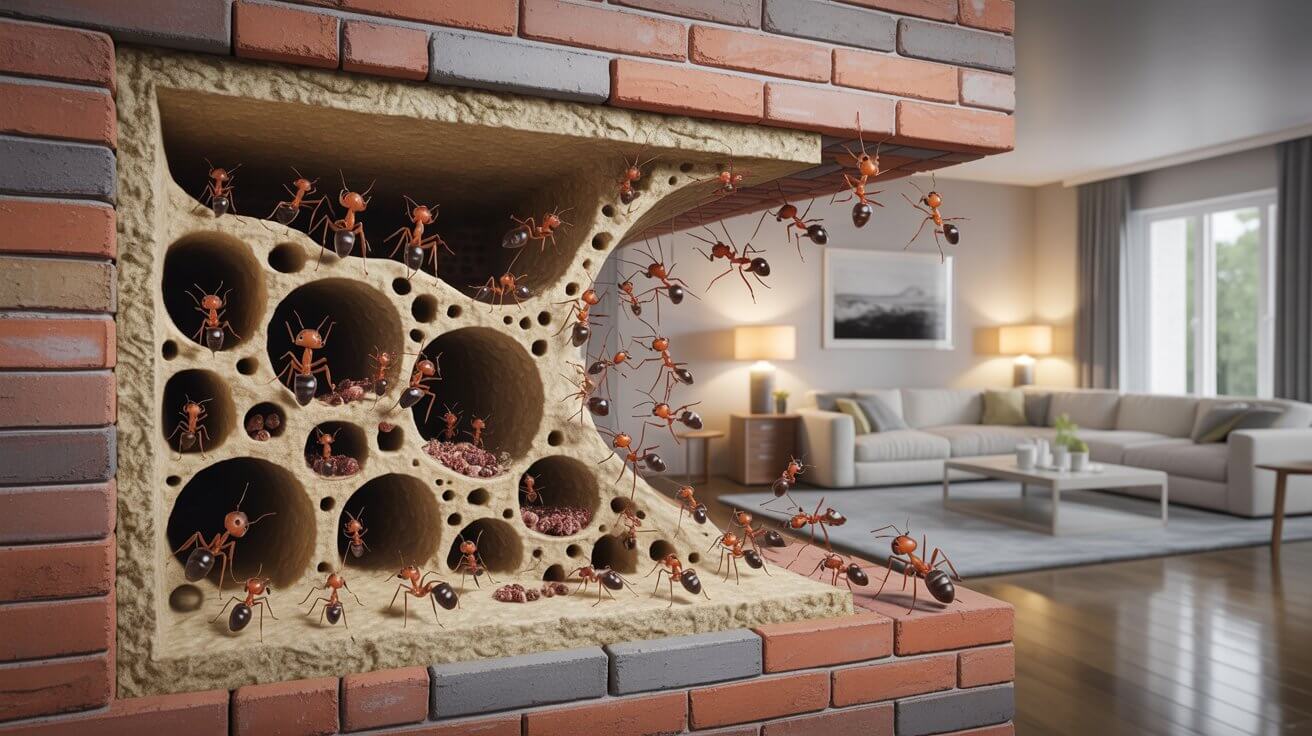
- Wall Cavities & Insulation: This is the prime location for indoor nests. The insulation materials (like polystyrene or foam) are easy for ants to excavate, providing a warm, insulated environment for the brood.
- Under Floorboards: The void between the ground and your floorboards is often damp and protected, making it ideal for Black Garden Ants.
- Bathrooms and Kitchens: Ants need moisture. Leaky pipes behind bath panels or under sinks create rotting timber, which is a magnet for nesting ants.
- Potted Plants: sometimes, a colony is accidentally brought inside. If a plant has been outside for the summer and brought in for winter, check the soil.
Identifying the Intruder: Common UK House Ants
Not all ants are the same. Identifying the species is crucial because the treatment method for one may worsen the infestation for another.
1. Black Garden Ant (Lasius niger)
- Appearance: Black or dark brown, 3-5mm long.
- Behaviour: Usually nest outside under paving slabs but will nest indoors in wall cavities if moisture is present. They are attracted to sweet, sugary foods.
- Treatment: Can be treated with residual sprays and baits.
2. Pharaoh Ant (Monomorium pharaonis)
- Appearance: Very small (2mm), yellow or light brown, almost transparent.
- Behaviour: Exclusively indoor ants. They love heat and are often found near heating pipes.
- WARNING: Do not use standard insect sprays on Pharaoh ants. When stressed by chemical sprays, the colony will undergo a process called “budding.” The Queen will split the colony into multiple smaller groups, spreading the infestation to every room in your house. They require specialist baiting programs.
3. Roger’s Ant (Hypoponera punctatissima)
- Appearance: Small, reddish-brown.
- Behaviour: They live in damp residues and drains. They rarely forage for food in the open but can inflict a painful sting.
Quick Guide: Common UK House Ants & Treatment Risks
| Ant Species | Visual Identifier | Typical Nest Location | Risk & Treatment Warning |
|---|---|---|---|
| Black Garden Ant (Lasius niger) | Dark brown/black, 3-5mm long. | Outdoors (patios, lawns), foraging indoors for sweets. | Low Risk. Standard baits work well. Primarily a nuisance pest. |
| Pharaoh Ant (Monomorium pharaonis) | Tiny (2mm), yellow-brown or translucent. | Warm voids: Boiler cupboards, behind ovens, heating pipes. | CRITICAL WARNING: Do not use store-bought sprays. Spraying causes “budding” (splitting the colony), making the infestation much worse. |
| Roger’s Ant (Hypoponera punctatissima) | Reddish-brown, visible stinger. | Damp, dark areas: Drains, behind shower tiles, cellars. | Moderate Risk. Their presence usually indicates a structural leak or damp issue that must be fixed first. |
Why You Should Not Ignore an Ant Colony
Homeowners often tolerate ants because they are not viewed as “dirty” like cockroaches or rats. However, ignoring an indoor colony is a mistake.
Hygiene Risks
Ants do not wash their feet. Before crawling across your chopping board or into your sugar bowl, they may have travelled through drains, bin stores, or over animal faeces. They are mechanical vectors for bacteria such as Salmonella, E. coli, and Staphylococcus.
Structural Integrity
While UK ants are not as destructive as termites, they can still cause damage. By excavating foam insulation or damp wood, they can compromise the thermal efficiency of your home and widen cracks, leading to further damp issues.
Electrical Fires
Strange as it sounds, ants are often attracted to electrical fields. They can nest inside fuse boxes, sockets, and appliances. Their bodies can create bridges between contacts, causing short circuits, equipment failure, and, in rare cases, fire hazards.
DIY vs. Professional Removal: What Works?
When you ask, “How do you know if there is an ant colony in your house?”, you are usually looking for a solution. Many homeowners immediately reach for boiling water, vinegar, or hardware store powders.
Why DIY Often Fails
Most DIY treatments are “contact killers.” You spray the line of ants, and they die. However, you have only killed the older workers. You have not touched the Queen, the larvae, or the thousands of reserve workers in the nest. The Queen will simply increase egg production to replace the losses.
Furthermore, as mentioned with Pharaoh ants, the wrong chemical can make the problem ten times worse.
The Professional Approach
At Saxon Pest Management, we use an integrated approach to ant control:
- Survey: We identify the exact species and locate the nest using the signs mentioned above.
- Baiting: We use professional-grade, slow-acting gel baits. The workers eat the bait but do not die immediately. They carry the poison back to the nest and feed it to the Queen and the larvae. This causes a “colony collapse” from the inside out.
- Proofing: We help identify entry points and moisture sources that attracted the ants in the first place.
Frequently Asked Questions (FAQ)
How long does an ant colony live in a house?
A Queen ant can live for up to 15 years, and as long as she is alive, the colony will persist. Seasonal activity may drop in winter, but without treatment, the nest remains active year after year.
Can ants damage my house foundation?
In the UK, it is unlikely ants will damage concrete foundations. However, they can remove sand and soil from beneath patio slabs and driveways, causing subsidence of paving, and they can damage internal timber and insulation.
What kills ants instantly but is safe for pets?
While soapy water kills ants on contact, it does not solve the infestation. For a pet-safe solution that actually eradicates the nest, professional bait stations are required. These are tamper-proof boxes that keep the poison away from curious pets but accessible to ants.
Why do I have flying ants in my bathroom?
Bathrooms provide moisture and often have access to wall cavities via pipework. If you see flying ants here, the nest is likely behind the bath panel or in the wall void.
Conclusion
Determining if there is an ant colony in your house requires more than just spotting a bug on the floor. It requires looking for patterns: the debris they leave behind, the sounds in the walls, and the timing of their appearance.
If you are seeing discarded wings, piles of frass, or persistent trails that return no matter how much you clean, you have a resident colony, not just a visitor. Do not let a small annoyance turn into a structural and hygiene crisis.
Don’t share your home with pests. If you suspect you have an ant colony in your property, contact Saxon Pest Management today. Our expert technicians are ready to provide a thorough survey and effective, lasting treatment to reclaim your home.